

Industry
Hospital Laboratory Network
Engagement Type
Laboratory Modernization Delivery
DealBridge Services
Strategic Advisory • Implementation Governance • Digital Diagnostics Strategy • Quality Systems Alignment
Executive Overview
A large hospital laboratory network faced increasing operational pressure as diagnostic testing demand grew across multiple clinical departments. While the laboratory had invested in additional instruments and digital systems over time, these upgrades were implemented incrementally and without a unified modernization strategy.
As testing volumes increased, operational complexity also grew. Turnaround times became inconsistent during peak periods, specimen routing created workflow bottlenecks, and digital interfaces between laboratory instruments and information systems generated operational inefficiencies.
Hospital leadership recognized that isolated upgrades would not resolve these challenges. A coordinated modernization program was required to improve efficiency, strengthen governance, and prepare the laboratory infrastructure for future diagnostic demand.
DealBridge Global was engaged to design and implement a structured modernization strategy that aligned workflow redesign, digital integration, and governance oversight through controlled project milestones.
The Situation
The hospital network operated a central diagnostic laboratory supporting emergency medicine, inpatient care, and specialized clinical programs. Over several years, testing demand increased steadily as clinical services expanded.
In response, the laboratory introduced new instruments and digital tools. However, because these upgrades occurred independently across departments, the overall diagnostic ecosystem gradually became fragmented.
Laboratory leadership began observing several operational warning signs:
- variability in turnaround times during peak testing periods
- specimen processing queues in specific workflow stages
- frequent exception handling due to digital interface limitations
- increasing staff workload and overtime
- limited visibility into real-time operational performance
These indicators suggested that the laboratory required a comprehensive operational redesign rather than incremental upgrades.
Core Challenge
The primary challenge facing the laboratory network was not testing capacity but operational coordination.
Modernization efforts involved multiple stakeholders including laboratory leadership, hospital administration, IT departments, procurement teams, and facilities management. Without a unified governance structure, modernization initiatives lacked coordination.
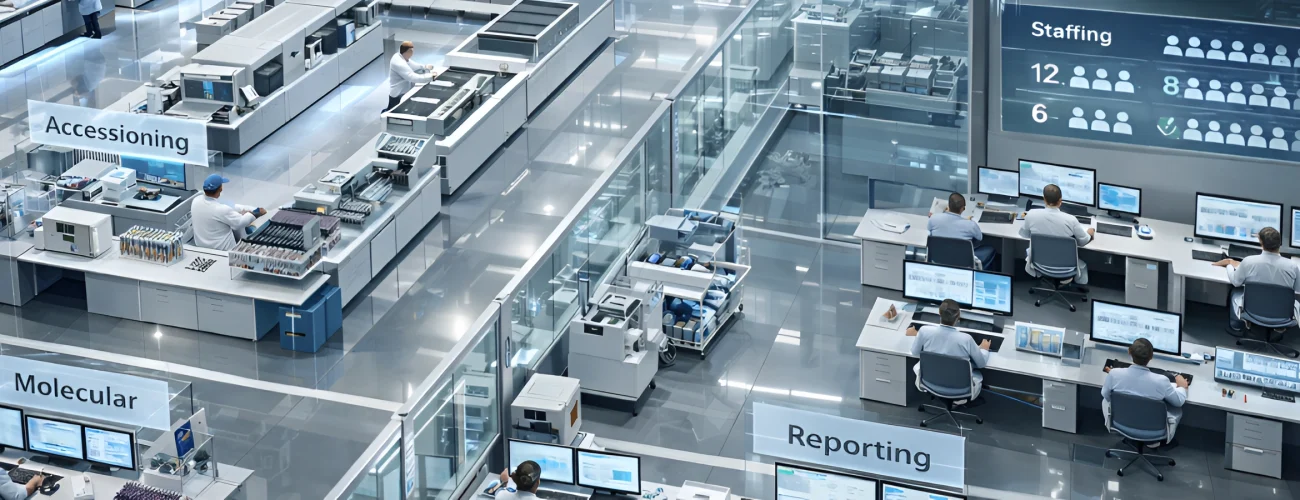
Workflow inefficiencies also contributed to operational strain. Specimen movement across pre-analytical, analytical, and post-analytical stages involved manual handoffs that created delays and rework.
Digital integration between instruments, middleware platforms, and LIS systems generated exception queues that required manual intervention. At the same time, operational changes needed to maintain compliance with laboratory accreditation requirements.
Addressing these challenges required a coordinated modernization strategy rather than isolated operational fixes.
The DealBridge Bridge Model
DealBridge structured the modernization program around a framework linking operational challenges with measurable outcomes.
Operational Challenges
Operational complexity across diagnostic workflows
Fragmented digital systems and interfaces
Manual specimen routing processes
Uncoordinated modernization initiatives
DealBridge Bridge
Structured governance architecture
Workflow engineering and operational redesign
Digital integration strategy
Milestone-based program management
Operational Outcomes
Predictable laboratory operations
Improved turnaround time stability
Greater operational visibility
Scalable diagnostic infrastructure
The DealBridge Approach
DealBridge implemented a modernization strategy built around four coordinated transformation pillars.
Program Governance
A modernization steering committee aligned decision-making across laboratory leadership, hospital administration, IT teams, procurement, and facilities management. Clear decision rights and escalation pathways ensured efficient program execution.
Operational Workflow Redesign
DealBridge assessed specimen flow across laboratory operations, identifying bottlenecks and redesigning workflows to streamline specimen movement and improve workload distribution.
Digital Integration Strategy
Laboratory digital infrastructure was evaluated to improve interoperability between instruments, middleware systems, and LIS platforms. Monitoring dashboards were introduced to enhance operational visibility.
Quality Systems Alignment
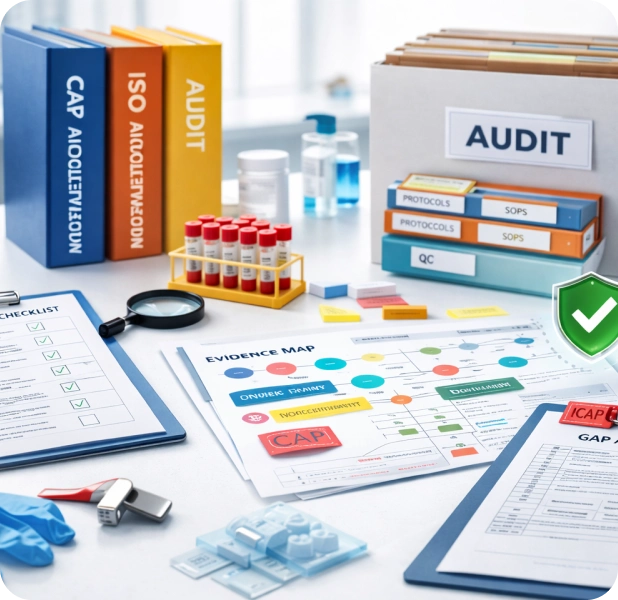
All modernization activities included structured validation procedures, documentation updates, and staff competency training to ensure continued compliance with accreditation standards.
Controlled Milestones
The modernization program was delivered through a stage-gated milestone framework.
Phase 1 – Baseline Assessment
Evaluation of workflows, digital systems, and operational performance.
Phase 2 – Future State Design
Development of redesigned workflows, layout optimization, and digital integration strategy.
Phase 3 – Implementation Planning
Creation of deployment plans, vendor-neutral requirements, and validation protocols.
Phase 4 – Deployment and Stabilization
Operational rollout supported by monitoring and continuous improvement.
Results
Following implementation of the modernization program, the laboratory network achieved several operational improvements.
Key outcomes included:
- improved turnaround time stability during peak periods
- reduced specimen processing bottlenecks
- improved digital monitoring of laboratory performance
- more balanced staff workload distribution
- stronger alignment between operational workflows and quality systems
These improvements created a more predictable and scalable diagnostic environment capable of supporting future testing demand.
Strategic Insight
Laboratory modernization is often approached as a technology upgrade. In practice, successful transformation requires coordinated improvements across governance, workflow design, digital integration, and quality systems.
DealBridge Global supports healthcare organizations in bridging strategy and execution to modernize diagnostic laboratories while maintaining operational stability and accreditation compliance.