

Industry
Tertiary Care Hospital Laboratory
Engagement Type
Laboratory Automation Strategy and Workflow Transformation
DealBridge Services
Strategic Advisory • Automation Planning • Workflow Engineering • Implementation Governance
Executive Overview
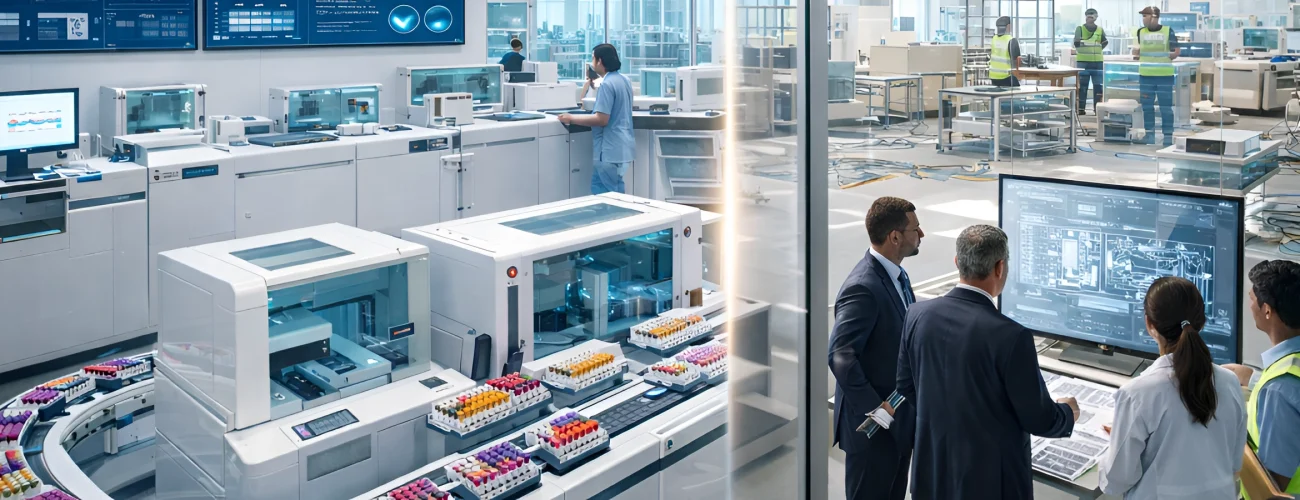
A large tertiary-care hospital laboratory faced increasing operational pressure as diagnostic testing demand grew across multiple clinical services. Although the laboratory had invested in additional analyzers over time, operational workflows remained largely manual and fragmented.
Specimen processing relied heavily on staff coordination between laboratory sections, creating bottlenecks during peak testing periods and increasing operational strain. Turnaround times became less predictable, prompting laboratory leadership to recognize the need for a modernization strategy capable of improving efficiency while maintaining service reliability.
DealBridge Global was engaged to evaluate laboratory operations and design a structured automation transformation strategy. Through workflow engineering, automation planning, and disciplined implementation governance, DealBridge helped the laboratory transition toward a more efficient and scalable operational model.
The transformation improved specimen flow, reduced processing delays, and established a foundation for sustainable diagnostic growth.
The Situation
The hospital laboratory supported a wide range of clinical services including emergency medicine, inpatient diagnostics, outpatient laboratory testing, and specialized diagnostic programs. As patient volumes increased and clinical services expanded, diagnostic testing demand also grew significantly.
To accommodate this growth, the laboratory introduced additional instruments and testing platforms over time. However, these systems were deployed independently rather than as part of an integrated automation architecture.
Specimen processing across the laboratory therefore relied heavily on manual routing between testing stations. Laboratory staff were responsible for transferring specimens between processing stages, coordinating instrument usage, and managing operational exceptions.
As testing demand continued to increase, several operational challenges emerged:
- specimen processing delays during peak testing periods
- workflow bottlenecks between laboratory sections
- increasing staff workload and operational fatigue
- inconsistent turnaround times for certain diagnostic tests
- limited visibility into real-time workflow performance
These indicators suggested that the laboratory required operational modernization beyond incremental equipment additions.
Core Challenge
The central challenge facing the laboratory was workflow efficiency rather than testing capacity.
Manual specimen routing created multiple handoffs between processing stages, increasing processing time and introducing opportunities for delay. Laboratory analyzers operated largely as standalone systems rather than as components of an integrated automation environment.
Operational visibility was also limited. Laboratory leadership lacked real-time insight into specimen flow, workload distribution, and processing capacity across different sections of the laboratory.
At the same time, implementing automation introduced operational risks. Without a carefully structured transition strategy, automation initiatives could disrupt ongoing laboratory services.
Addressing these challenges required a coordinated transformation strategy capable of improving workflow efficiency while maintaining operational continuity.
The DealBridge Bridge Model
DealBridge structured the automation transformation program around a framework linking operational challenges with measurable outcomes.
Operational Challenges
Manual specimen routing
Fragmented analyzer operations
Workflow bottlenecks across laboratory sections
Limited operational visibility
DealBridge Bridge
Workflow engineering and process redesign
Automation architecture planning
Instrument integration strategy
Milestone-based implementation governance
Operational Outcomes
Streamlined specimen flow
Improved laboratory efficiency
Reduced operational bottlenecks
Scalable laboratory automation infrastructure
The DealBridge Approach
DealBridge implemented a structured automation transformation program built around four coordinated components.
Operational Workflow Assessment
DealBridge conducted a comprehensive evaluation of specimen flow across laboratory operations, mapping specimen movement through pre-analytical, analytical, and post-analytical stages to identify inefficiencies and bottlenecks.
Automation Strategy Development
Based on workflow analysis, DealBridge designed an automation strategy aligned with the laboratory’s operational needs and long-term diagnostic growth. Automation technologies were evaluated to improve specimen routing, instrument coordination, and workflow efficiency.
Digital Integration Planning
Automation initiatives were supported by digital integration planning to ensure connectivity between analyzers, middleware platforms, and laboratory information systems. This integration improved specimen routing and data visibility across laboratory operations.
Implementation Governance
DealBridge established governance structures to coordinate automation implementation across laboratory leadership, IT teams, procurement departments, and hospital administration. This ensured that operational transformation progressed with clear oversight.
Controlled Milestones
Automation transformation was delivered through a stage-gated milestone framework designed to maintain operational stability.
Phase 1 – Operational Assessment
Evaluation of specimen workflows, testing volumes, and automation readiness.
Phase 2 – Automation Design
Development of automation architecture, workflow redesign, and digital integration strategy.
Phase 3 – Implementation Planning
Preparation of deployment schedules, operational transition plans, and staff training programs.
Phase 4 – Deployment and Optimization
Gradual implementation of automation systems supported by performance monitoring and continuous improvement.
Results
Following implementation of the automation transformation program, the laboratory achieved several operational improvements.
Key outcomes included:
- improved efficiency in specimen processing workflows
- reduced bottlenecks across laboratory sections
- improved turnaround time stability during peak testing periods
- better workload balance for laboratory staff
- improved operational visibility for laboratory leadership
These improvements enabled the laboratory to support increasing diagnostic demand while maintaining reliable diagnostic services.
Strategic Insight
Laboratory automation delivers the greatest value when combined with workflow redesign and disciplined implementation governance.
Automation technologies alone cannot resolve operational inefficiencies if laboratory processes remain unchanged.
DealBridge Global supports healthcare organizations in modernizing laboratory operations by aligning automation strategy with workflow engineering and structured execution.