

Industry
Hospital Diagnostic Laboratory System
Engagement Type
Laboratory Capital Planning and Equipment Utilization Strategy
DealBridge Services
Strategic Advisory • Capital Infrastructure Assessment • Diagnostic Platform Optimization • Implementation Governance
Executive Overview
Hospital laboratories frequently invest in advanced diagnostic equipment to support expanding clinical programs and improve testing capacity. However, without structured capital planning and governance, laboratories may accumulate high-value technologies that remain underutilized.
A hospital diagnostic laboratory system encountered growing concerns regarding capital efficiency after several years of incremental equipment acquisitions. Multiple diagnostic platforms had been introduced across laboratory departments, yet leadership observed that several high-cost instruments were operating below their intended capacity.
At the same time, certain specialized tests continued to be referred to external laboratories despite the presence of internal equipment capable of supporting these services.
Hospital leadership recognized that the challenge was not the availability of technology but the absence of a coordinated framework linking diagnostic demand, laboratory workflows, and capital investment decisions.
DealBridge Global was engaged to conduct a strategic assessment of the laboratory’s diagnostic infrastructure and develop a structured capital optimization strategy aimed at improving equipment utilization and strengthening capital planning governance.
The Situation
The hospital laboratory system supported a broad range of diagnostic services including emergency testing, inpatient diagnostics, outpatient laboratory services, and specialized clinical programs.
Over several years, new diagnostic platforms had been introduced to support emerging testing capabilities such as molecular diagnostics, specialized microbiology services, and advanced chemistry platforms.
Many of these acquisitions addressed immediate operational needs or clinical program expansion. However, because equipment investments were made incrementally across departments, the laboratory infrastructure gradually became fragmented.
Laboratory leadership began observing several operational inefficiencies.
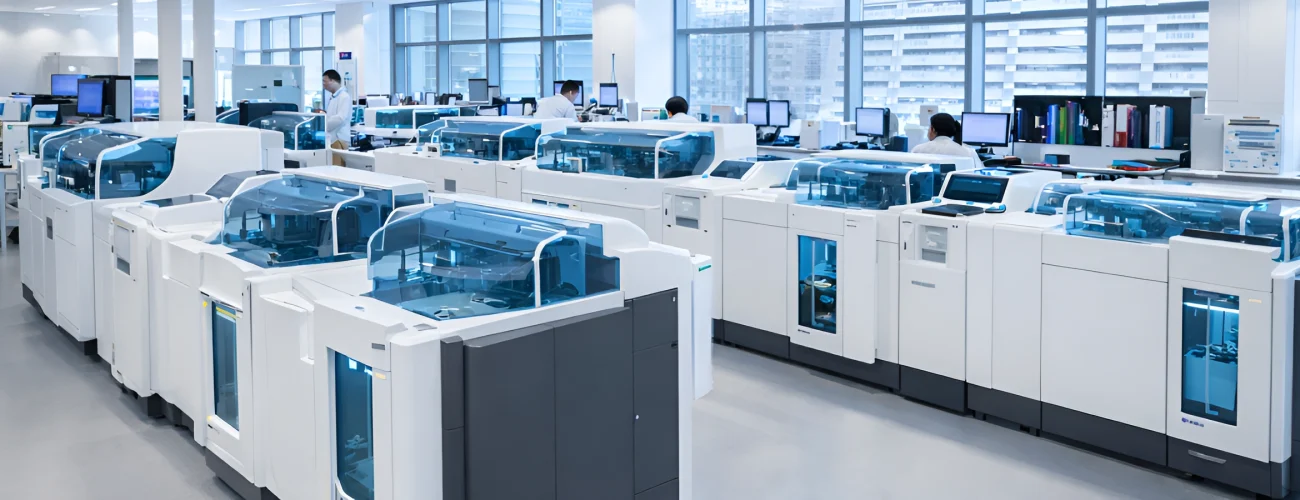
Some diagnostic instruments were operating at relatively low testing volumes, while others experienced workflow congestion during peak demand. In several cases, similar diagnostic technologies existed in different laboratory sections, leading to duplication in service contracts, reagent supply chains, and technical expertise.
Laboratory workflows had also evolved independently across departments, preventing certain platforms from being used at their full capacity.
Without a structured capital planning process, leadership found it difficult to determine whether future equipment investments aligned with long-term diagnostic strategy.
Core Challenge
The primary challenge facing the laboratory system was optimizing the value of existing diagnostic infrastructure while establishing a structured framework for future capital planning.
Equipment acquisitions had occurred independently across departments, creating a fragmented instrumentation landscape with overlapping diagnostic capabilities.
Utilization levels varied significantly across instruments. Some platforms operated well below their intended throughput capacity, while others supported critical workflows under heavy operational demand.
Operational workflows had also developed independently across laboratory sections, sometimes preventing laboratories from fully leveraging the capabilities of existing diagnostic technologies.
In addition, procurement decisions were not always supported by centralized planning connecting diagnostic demand forecasting, equipment lifecycle management, and long-term laboratory development.
Addressing these challenges required both operational workflow improvements and structured capital planning governance.
The DealBridge Bridge Model
DealBridge structured the capital optimization initiative around a framework linking operational challenges with sustainable infrastructure outcomes.
Operational Challenges
Fragmented equipment acquisition
Low utilization of diagnostic platforms
Duplicated diagnostic technologies
Limited capital planning governance
DealBridge Bridge
Laboratory infrastructure assessment
Equipment utilization optimization
Platform standardization
Strategic capital planning framework
Operational Outcomes
Improved equipment utilization
Reduced technology duplication
Stronger investment governance
Sustainable diagnostic infrastructure planning
The DealBridge Approach
DealBridge implemented a structured capital optimization strategy addressing infrastructure utilization, workflow alignment, and procurement governance.
Capital Infrastructure Assessment
DealBridge conducted a comprehensive evaluation of diagnostic platforms across laboratory departments. The assessment examined equipment capacity, utilization levels, testing volumes, and integration with laboratory workflows to identify opportunities for improvement.
Workflow Optimization
Laboratory workflows were reviewed to determine how testing pathways could better utilize existing equipment. In several areas, testing processes were redesigned to concentrate activity on high-throughput platforms capable of supporting larger diagnostic volumes.
Platform Rationalization
DealBridge supported laboratory leadership in identifying opportunities to reduce duplication across diagnostic technologies. Where appropriate, testing services were consolidated onto standardized platforms capable of supporting multiple diagnostic applications.
Capital Planning Governance
A structured capital planning framework was introduced to guide future equipment acquisitions. Procurement decisions were aligned with diagnostic demand forecasts, clinical program development, and long-term laboratory infrastructure strategy.
Controlled Milestones
The capital optimization initiative was delivered through a structured milestone framework.
Phase 1 – Infrastructure Assessment
Evaluation of diagnostic platforms, utilization levels, and workflow integration.
Phase 2 – Optimization Strategy Design
Identification of opportunities to improve equipment utilization and reduce technology duplication.
Phase 3 – Workflow Alignment
Redesign of diagnostic workflows to better match testing demand with equipment capacity.
Phase 4 – Capital Governance Framework
Implementation of structured processes for future equipment planning and procurement
Results
Following implementation of the capital optimization strategy, the laboratory system achieved several operational improvements.
Key outcomes included:
- improved utilization of existing diagnostic equipment
- reduced duplication across laboratory technologies
- improved alignment between testing demand and equipment capacity
- strengthened governance over capital investment decisions
- improved long-term planning for laboratory infrastructure development
These improvements allowed the laboratory system to maximize the value of existing technology investments while supporting future diagnostic growth.
Strategic Insight
Diagnostic equipment represents a major capital investment for healthcare systems. However, technology alone does not guarantee operational efficiency.
Effective laboratory infrastructure requires governance structures that align equipment selection, workflow design, and capital planning with diagnostic demand.
DealBridge Global helps healthcare organizations transform fragmented diagnostic infrastructure into coordinated laboratory ecosystems that maximize the value of technology investments while supporting sustainable diagnostic growth.